Showing posts with label Science. Show all posts

Wednesday, October 8, 2014

The Blood Moon is upon us!


A "Blood Moon" is so named due to the reddish color that tints the Moon during a total lunar eclipse.  This rare event only takes place during a the night of the full moon phase when the Moon passes into shadow (or umbra) of the Earth.


Throughout the ages and across a variety of cultures this astronomical event has been interpreted as a bad omen which served to foreshadow famines and other calamities.  Ancient civilizations such as the Egyptians and Incans thought that during a lunar eclipse the Moon was swallowed by a demon or some sacred animal.  Advanced cultures such as the Greeks recognized lunar eclipses as evidence for the Earth being round.


My wife and I are rarely able to witness such amazing celestial phenomena due to our schedule, so we were very excited to have the chance to witness the lunar eclipse early this morning.  Of course, as our luck would have it, it was a very cloudy, foggy morning...  Still, we were able to catch a glimpse of the eclipse and the red Moon every once in a while.  I can only imagine what it must have looked like in clear conditions!

Oh well,  maybe next time...

Thursday, August 14, 2014

Real Sea Monsters


There's something genuinely terrifying - yet alluring - about the creatures that lurk in the abysmal darkness of the oceans' deepest depths. It's hard to believe that organisms so horrifying in appearance actually exist outside of our nightmares.


I've wanted to do a post like this for a while, but, in all honestly, I freaked myself out any time I sat down to search for images... I'm definitely a land-lubber!

Saturday, August 9, 2014

"A Canticle for Leibowitz"


My high school English Literature teacher, Mr. Mayfield, was very much into Science Fiction, Fantasy, and comic books.  Suffice to say, we got along quite well.  For the most part (More on that another time perhaps...).  He always chose unorthodox books and stories for us to read and analyze in class.  We never knew what he would pull off the shelf!

One such book was Walter Miller Jr.'s "A Canticle for Leibowitz", which I gained a genuine appreciation for long after high school.

The book a post-apocalyptic Science Fiction novel set 600 years after the "Flame Deluge", a worldwide nuclear war which destroys modern civilization.  Following the cataclysm, society devolves as it violently turns its back on scientific advancements.  The majority of the survivors blame the disaster on technology and the pursuit of knowledge.  The irradiated, partially mutated mobs - proudly calling themselves "Simpletons" - set about burning books, killing readers, and shunning all forms of learning during an revolutionary event called the "Simplification".

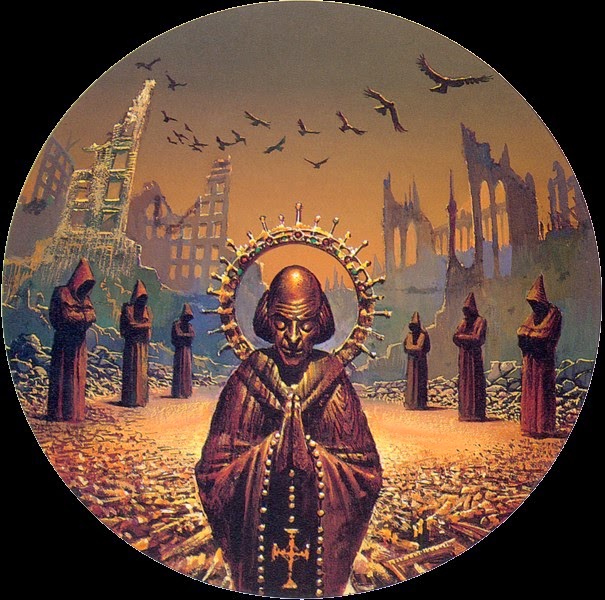
This is the artwork of the edition we read my sophomore year of high school.  I like to think that it reflects all the good times we had!
During the Simplification, a Jewish electrical engineer named Isaac Edward Leibowitz forms a Roman Catholic monastic order called the Albertian Order of Leibowitz which is based at an abbey in the desert of the American Southwest.  The mission of the Order is to preserving knowledge  for future generations.  Thus, the monks save as many published works as possible, smuggle books (booklegging), memorize and copy entire texts, and actively search for new artifacts from the previous age called "Memorabilia".


I never really thought about it at the time, but I suppose this book could easily have been considered somewhat subversive by either the administration or parents in our small town.   A major point of interest of the plot is that the author depicted the monks, an embodiment of religious establishment, defending and protecting scientific knowledge.  Obviously this would be considered atypical, a juxtaposition for most.  Indeed, the Catholic church and a variety of establishments professing faith have had a history and continuing reputation of suppressing and stifling scientific progress and discovery through the ages.

However, I don't remember anyone in our local religious community raising a fuss and the book had no major effects on my faith.  The preacher of the church I attended while growing up, he was a Chemistry teacher with an engineering background and was a candidate to participate in NASA's Teacher in Space Project.  Without going into my beliefs too much (I have a whole other blog for that) I have always felt that Science informed my faith and actually reinforced it rather than contradict or destroy it. To me, truth is truth, regardless of the source.

But, anyway...  Getting back to the book itself:  

I didn't realize it, but Miller was a well-established Science Fiction writer during the 50's, writing stories for several magazines at the time.  Apparently "A Canticle for Leibowitz" was originally developed as a standalone short story which comprises the book's first section.  After completing another short story set in the same universe, Miller decided to make some revisions and add a third part to create a cohesive novel.

In the end, the book is made up of three sections which skip ahead in the world's timeline.  Without spoiling too terribly much, the book reveals a cyclic societal history that could call into question the original civilization's true beginnings.

I remember being impressed by Miller's world-building (this was long before I was aware of such a term) and fascinated by the ideas presented in the novel.  I recall discussing with my friends the possibilities of various future religions discovering artifacts from our own civilization and mistakenly attributing great spiritual significance upon them.  Behold:  The Holy Game-Boy of Saint Smith!

Overall, the book is a great read and I recommend it for anyone interested in Post-Apocalyptic literature or just a good Science Fiction story. 

Saturday, May 31, 2014

Cryptic Curiosities: Pepper's Ghost


During the Victorian Era, many were fascinated with afterlife, ghosts, and communicating with spirits.  Thus, spiritualism was a major near-religion for people during this time in history.  Psychic readings, séances, spirit photography, and other curiosities sought to appease the public's hunger for the supernatural.  Additionally, the "Ghost Show" was born.

The Ghost Show allowed audience members to witness the appearance of spirits in the comfort of the theater.  However, the conjuring of these ghosts was actually a clever illusion devised by the creator of the Ghost Show, John Henry Pepper. Unlike many "ghost-makers" during this time, Pepper never attempted to pass off his ghosts as anything more than illusion and did not seek to take advantage of his audience, but to entertain and even educate.


Pepper, a professor of chemistry, developed the illusion by taking advantage of successive reflections (the same kind of reflections you might notice in the glass as you ride in a car at night).  The trick worked in this way:  A projectionist below the stage shined an intense beam of light on an actor portraying a ghost.  A large sheet of glass tilted at a 45 degree angle toward the audience reflected the image of the actor below to give the audience the illusion of a semi-transparent "ghost" on stage.  Through careful coordination and stage direction, actors were able to interact with the fabricated phantoms.


A similar technique is occasionally used even to this day to create 3-dimensional holograms.

Tuesday, April 8, 2014

Freaky Factoids: Thagomizer


Did you know that the "business end" of a Stegosaurus' tail had a name?  Apparently, the part of the tail adorned with the rows of sharp spikes (thought to be used as a means of defense against potential prehistoric predators) is called the thagomizer.

It turns out that the term owes its origin to an old Far Side comic by the cartoonist Gary Larson.


I suppose this could be considered one of those situations in which life imitates art...

Saturday, March 29, 2014

The Art of Charles Knight


Charles Knight (1874-1953) was a superbly talented painter and sculptor who is most famous for his depictions of prehistoric life.  Despite being legally blind, Knight began his career in illustration primarily focusing on nature.

Knight had a keen interest in natural history and spent much of his time visiting the American Museum of Natural History where he was asked by a curator to do some restoration work.  Being thoroughly pleased with the final product, the museum gave Knight a steady stream of commission work.  others across the nation commissioned Knight to do a number of individual paintings and huge murals depicting prehistoric creatures including ancient mammals, neanderthals, and dinosaurs.

Knight sculpting a Stegosaurus
Knight later in life
Although he had a reputation of viewing his pieces as works of art first and foremost, Knight had a great sense of anatomy which he put to great use depicting creatures that had never been seen by modern eyes.  However, much of his work is considered to be anatomically incorrect by today's paleontological standards.  In spite of this, it is impossible to deny the inspirational legacy of Knight's artwork and the impact it has had on generations of aspiring fossil hunters.