Showing posts with label Lon Chaney. Show all posts
Wednesday, October 5, 2016
Classic Horror on TCM!
Well... Good job, Turner Classic Movies. I'm not going to have much room left on my DVR after October!
I don't know how many of you have access to the TCM channel, but I thought I would share a portion of their programming schedule for this month which is dedicated to classic horror films! TCM is celebrating Halloween all month long with a great selection of vintage movies, including films from the silent era, the original Universal classics, and the Hammer films as well!
Friday, 7th
Nosferatu (1922) @ 8pm
The Cabinet of Dr. Caligari (1920) @ 9:45pm
The Unholy Three (1925) @ 11:15pm
Phantom of the Opera (1925) @ 1am
Saturday, 9th
Ghost of Frankenstein (1942) @ 8pm
Frankenstein meets the Wolfman (1943) @ 9:15
House of Frankenstein (1944) @ 10:45pm
Dr. Jekyll and Mr. Hyde (1920) @ 12:15
Sunday, 16th
The Curse of Frankenstein (1957) @ 8pm
The Revenge of Frankenstein (1958) @ 9:45pm
Monday, 17th
Horror Hotel (1960) @ 8pm
Horror Express (1972) @ 9:30pm
The House that Dripped Blood (1970) @ 11:15pm
The Creeping Flesh (1972) @ 1:15am
February, 21st
Dr. Jekyll and Mr. Hyde (1941) @ 8pm
Eyes Without a Face (1960) @ 10:00pm
The Body Snacher (1945) @11:45pm
Phantom of the Rue Morgue (1954) @ 1:15am
Machabre (1958) @ 2:45am
Saturday, 22nd
The Killer Shrews (1959) @ 6:45am
The Devil Bay (1940) @ 8am
The Seventh Victim (1943) @ 9:15am
Sunday, 23rd
Frankenstein Created Woman (1967) @ 8pm
Frankenstein Must Be Destroyed (1970) @ 10pm
The Phantom Carriage (1922) @ 12am
Epidemic (1987) @ 2am
Monday, 24th
The Gorgon (1964) @ 3:15pm
The Curse of Frankenstein (1957) @ 4:45pm
Rasputin, the Mad Monk (1966) @ 6:15pm
House of Dracula (1958) @8pm
Dracula, Prince of Darkness (1965) @ 9:30pm
Dracula Has Risen from the Grave (1969) @ 11:15pm
Taste The Blood of Dracula (1970) @ 1am
The Scars of Dracula (1970) @ 2:45am
Dracula A.D. (1972) @4:30am
Wednesday, 26th
The Robot vs The Aztec Mummy (1965) @ 6am
The Time Machine (1960) @ 7:15am
Time After Time (1979) @ 9am
The Ice Pirates (1984) @ 1pm
Satellite In the Sky (1956) @ 2:45pm
Logan's Run (1975) @ 4:15pm
Soylent Green (1973) @ 6:15pm
Friday, 28th
Dracula (1931) @ 8pm
The Mummy (1932) @ 9:30pm
The Invisible Man (1933) @ 11pm
THE Wolfman (1941) @ 12:15am
The Black Cat (1934) @ 1:30am
The Uninvited (1944) @ 2:45am
Island of Lost Souls (1933) @ 4:30am
Saturday, 29th
The She-Doll 1936 @ 6am
Bedlam (1946) @ 9am
The Black Scorpion (1957) @ 12pm
The Blob (1958) @ 1:45pm
Village of The Dammed (1961) @ 3:15pm
The Thing From Another Would (1951) @ 4:45pm
Earth vs The Fling Saucers (1956) @ 6:30pm
Blood and Black Lace (1964) @ 8pm
Carnival of Souls (1962) @ 9:30pm
It's Alive (1974) @ 11pm
The Baby (1973) @ 12:45pm
Sunday, 30th
The Tingler (1959) @ 12pm
The Hunchback of Notre Dame (1939) @ 1:30pm
The Abominable Dr. Philbes (1971) @ 6pm
Young Frankenstein (1974) @ 8pm
Abbott And Costello Meet Frankenstein (1947) @ 10pm
The Monster (1925) @ 12am
Monday, 31st
Mark of The Vampire (1935) @ 6am
Walk With A Zombie 1943) @ 8:30am
Dementa 13 (1963) @ 9:45am
House of Wax (1953) @ 11:15am
Black Sabbath (1964) @ 12:45pm
Dead of Night (1945) @ 2:30pm
House on Haunted Hill (1958) @ 4:30pm
The Haunting (1963) @ 6pm
The Devils Bride (1968) @ 8pm
The Mummy (1959) @ 9:45pm
The Two Faces of Dr. Jekyll (1961) @ 2:45am
To The Devil, A Daughter (1976) @ 4:30am
Labels:
Bela Lugosi,
Boris Karloff,
Frankenstein,
Hammer,
Horror,
Lon Chaney,
Lon Chaney Jr.,
Monsters,
Movies,
Peter Lorre,
Silent Films,
Television,
Universal,
Universal Monsters,
Vampires,
Vincent Price,
Zombies
Thursday, March 12, 2015
The Art of Basil Gogos
Basil Gogos is a celebrated artist best known for his cover artwork for classic issues of "Famous Monsters of Filmland". His signature style features saturated colors and dramatic lighting, resulting in striking and unforgettable images.
![]() |
| Basil Gogos |
Thursday, June 26, 2014
Friday, April 11, 2014
The Phantom of the Opera (1925)
“If I am the phantom, it is because man's hatred has made me so. If I am to be saved it is because your love redeems me.”
Following the success of The Hunchback of Notre Dame in 1923, Universal began to plan the production of another epic spectacle. In 1925 the studio released their silent adaptation of The Phantom of the Opera.
The Phantom of the Opera is based on the novel of the same title by Gaston Leroux. Taking place in the Paris Opera House, the story begins with the new owners scoffing at the legend of "The Phantom"... until a mysterious figure is witnessed making a startling appearance in Box Five before vanishing.
The shadow of the Phantom is witnessed stalking the backstage area by many of the workers who nervously exchange rumors. The owners then begin receiving letters from the Phantom, demanding that they give the lead role in the opera to the young Christine. The managers refuse which prompts the Phantom's wrath. The Phantom ends up dropping the opera house's huge, grand chandelier, crushing numerous patrons.
Thus, Christine is given her moment in the spotlight during the next performance. She puts on an amazing performance and receives a standing ovation from the crowd. Raoul, Christine's fiancé, awaits outside her dressing room to congratulate her but is stunned to find that she has disappeared. It is revealed that Christine has been receiving music lessons from a mysterious voice for years. This "voice" turns out to be that of the Phantom, who captures Christine.
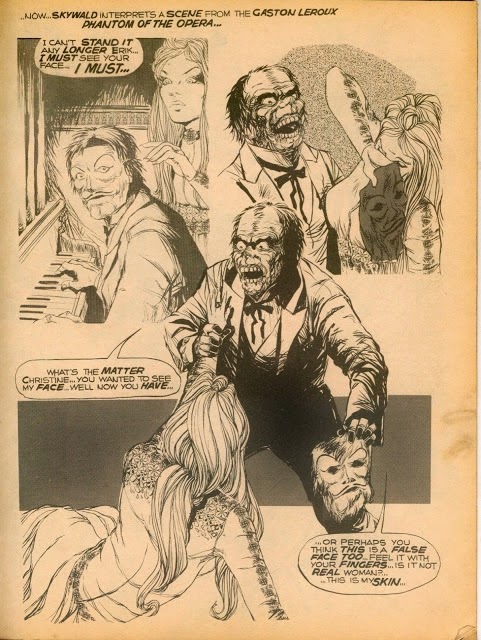
The masked Phantom takes Christine to his lair through a series of labyrinthine subbasements deep beneath the opera house. The Phantom professes his love for Christine, but when Christine's curiosity gets the best of her and she unmasks the Phantom, she is horrified to see his disfigured face. This is seen as an act of betrayal by the angered Phantom. He allows Christine to escape, but only on the condition that she never sees Raoul again. When she later attempts to meet Raoul in secret, the Phantom vows revenge!
With a budget of 1 million dollars, this production proved to be just an ambitious undertaking as The Hunchback of Notre Dame. Just as in the aforementioned film, thousands of extras were employed to portray the opera house's audience, performers, and stage hands. However, unlike its predecessor, for this film no trick shots or matte paintings were utilized by the filmmakers to give it its epic scope. The scale of the opera house is realistic because a practical, full five-story replica was built in Universal's back lot. Additionally, the Phantom's subterranean lair, including an underground river, was actually constructed.
The extravagant budget also allowed some scenes to be filmed in color, utilizing the then-new method of Technicolor. The scenes filmed in color included a masquerade ball in which the Phantom, disguised the Red Death, confronts Christine and Raoul.
Lon Chaney took on the role of the Phantom and was once again allowed to create his own makeup and prosthetics to create the gruesome visage of the titular character. Chaney's Phantom makeup remains a shocking sight to behold even to this day. To create the effect of a skull-like face, Chaney wore a set of false teeth and a bald cap with wisps of greasy, black hair. He glued his ears to the side of his head, and, using putty, exaggerated his cheekbones. He also used a piece of material to pull his nose straight up and then used wire to enlarge his nostrils which gave the appearance of not having a nose. To complete the effect, Chaney made his eyes seem larger by strategically placing white and black paint on his lower and upper eyelids.
The chaos depicted on screen was somewhat mirrored by some real-life turmoil on the set due to friction between Lon Chaney and the director, Rupert Julian. Apparently the situation was so bad that the actor and director would not directly speak to one another, but depended on communication through other crew members!
In spite of all this, The Phantom of the Opera remains a classic.
For your viewing pleasure:
Saturday, February 15, 2014
The Hunchback of Notre Dame (1923)
Released in 1923, The Hunchback of Notre Dame was a highly ambitious film released by Universal Studios. With massively elaborate sets, a "cast of thousands", and a stellar troupe of actors this movie was destined to become a classic.
An adaptation of Victor Hugo's novel, The Hunchback of Notre Dame is a silent film that takes place in 15th century France and tells the story of Quasimodo, a deaf, half-blind hunchback who serves as the bell-ringer for the Notre Dame Cathedral. Quasimodo lives a peaceful life in spite of his disdain for the people of the outside world. But all of that changes when his master becomes obsessed with the beautiful gypsy Esmeralda and bids the hunchback to kidnap the girl, setting into motion a series of events forever change Quasimodo.
For this movie (and subsequent other period films) Universal created a huge medieval back lot which included a painstakingly replica of Notre Dame's cathedral. Using glass matte paintings and long shots, the filmmakers convincingly recreated 15th century France. The advertisements at the time spectacularly boasted that the film had "a cast of thousands", but this actually was the case. Universal hired hundreds of actors to portray crowds of peasants, soldiers, and other background characters. Indeed, this film is grand spectacle on a truly epic scale.
Despite being more of a drama than an actual horror movie, the plot primarily focuses the character Esmeralda and her plight against a backdrop of class warfare. However, Lon Chaney's performance as the titular hunchback earns his portrayal of Quasimodo a place amongst the other iconic "Universal Monsters".
Lon Chaney puts on a spectacular performance as Quasimodo, showing a wide range of emotions even while wearing the various appliances he uses to give the appearance of the deformed hunchback. Lon Chaney was often called "the man of a thousand faces" because of his innovations in theatrical make-up and prosthetics that allowed him to become a variety of characters throughout his career including the "vampire" from London After Midnight and Erik from The Phantom of the Opera.
Personally, I really enjoyed this film and would recommend it to anyone who enjoys the old silent films. I'd always heard about Chaney's performance in this film and I was glad to see that much of the hype was true. Quasimodo is a character that you can definitely sympathize with and this is thanks very much to the actor who masterfully portrayed him.
For your viewing pleasure:
Subscribe to:
Posts (Atom)


.jpg)


_NRFPT_02.jpg)